EXPLORE
Students beginning career and higher-education exploration
Build awareness of disciplines, careers, courses and learning environments before students narrow their options.
Grade 10 → 11
We use optional analytics only if you accept. Names, emails and phone numbers are never sent to analytics. See the Cookie Policy.
Better Career Decisions Start Before College.
A structured career and higher-education development programme helping students explore careers, understand courses, compare universities, build future-ready skills and plan their next step.
Delhi NCR, India
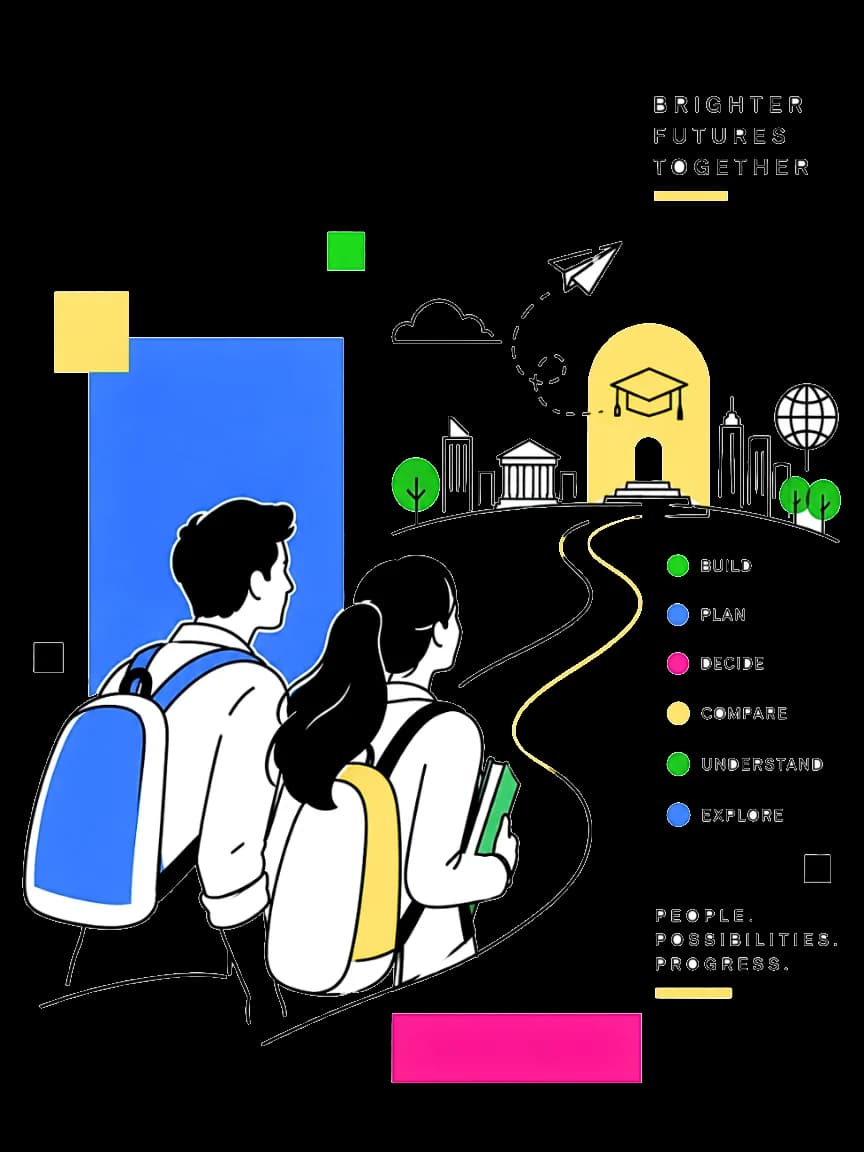
270+
Students Per School
Across the three-day school experience
540+
Parents Per School
Parent-facing programme engagement
10+
Participating Schools
Delhi NCR
3-Day
School Experience
One day per transition stage
3-Year
School Partnership
A sustained journey for the school
What this is
The Career & Future Skills Programme is delivered through schools. It helps students in the Grade 10 to Grade 12 transition years understand themselves, explore careers, evaluate courses and universities, and make informed decisions about their next step, with parents and schools involved.
We don’t tell students what to become. We teach them how to decide.
It is not
Students choose subjects in Grade 10, pathways in Grade 11 and courses in Grade 12, often with fragmented information and little time. Parents make high-value decisions with incomplete information. Schools want to help while balancing academic priorities.
Better decisions come from structured exploration at each stage, before the application deadline arrives.
Each stage matches a real decision point. The three-year model is a partnership with the school: students take part in the stage that fits where they are. They do not each attend for three years.
Students beginning career and higher-education exploration
Build awareness of disciplines, careers, courses and learning environments before students narrow their options.
Grade 10 → 11
Students evaluating careers, courses and university pathways
Help students explore career pathways, compare courses and understand what different universities and programmes offer.
Grade 11 → 12
Students making their post-Class 12 decisions
Support students as they move from school to higher education, including course selection, university comparison, applications, scholarships and next-step planning.
Class 12 → University
Each day is built for one primary cohort and moves from learning to discovery to reflection: orientation, a core session, discovery windows, expert sessions, action planning and Passport completion. Core programme hours are approximately 9:00 AM – 2:00 PM, subject to school timings, the school calendar and operational requirements.
Primary cohort: Grade 10 → 11
What the day may cover
Career & Future Skills Passport
Students record what they are drawn to, test it against real career families and note one pathway to investigate further.
Primary cohort: Grade 11 → 12
What the day may cover
Career & Future Skills Passport
Students compare two programmes with the programme’s evaluation framework before and after meeting universities.
Primary cohort: Class 12 → University
What the day may cover
Career & Future Skills Passport
Students and families leave with a written next-step plan: options, trade-offs, deadlines and the questions still to answer.
University Discovery meets students when they are exploring, comparing and deciding their next step. Students first learn the programme's own evaluation framework. Universities share their perspective; they do not set the framework.
Experience zones may include, depending on the school and partner ecosystem:
Practise it now with the University Scorecard.
Career & Future Skills Passport
Explore. Ask. Compare. Discover. The Passport guides students through short, meaningful interactions. It is not a stamp card: each entry is a question asked, a comparison made or a decision recorded.
Structure: 10 curated passport experiences + additional discovery experiences.
AI and digital literacy, problem solving, communication and adaptability, taught alongside career choices rather than as a separate buzzword. Future-skills sessions, and a Future Skills zone where available, give students hands-on exposure.
Parents may attend their child's primary day and may be invited to other sessions, depending on school policy. The aim is better conversations at home about courses, costs, scholarships and India versus abroad, without deciding for the student.
Build a sustained career and future-readiness journey across three academic years, or start with one year of the three-day experience. The school keeps control of scheduling, cohorts and partner activity on campus.
A defined journey across three transition stages, not a one-off talk.
Students learn how to evaluate careers, courses and universities, and can reuse the method.
Curated University Discovery after students have learned what to ask.
Emerging skills and technologies connected to real pathways.
Families take part on their child’s primary day, subject to school policy.
A signature experience that turns a busy day into recorded decisions.
Worksheets and guides students and families can use after the programme.
For three-year partners, an agreed calendar of student-development activities.
Not every university needs to engage with every cohort. Tell us which students you want to reach, and we will build an engagement plan around that moment.
Build awareness of disciplines, careers, courses and learning environments before students narrow their options.
Grade 10 → 11
Help students explore career pathways, compare courses and understand what different universities and programmes offer.
Grade 11 → 12
Support students as they move from school to higher education, including course selection, university comparison, applications, scholarships and next-step planning.
Class 12 → University
Optional pathway
For universities that only want to meet Class 12 students who have appeared for their boards and are actively evaluating admissions. Eligible post-board Class 12 students available at the participating school, subject to school calendar, student participation and programme scheduling.
Every partnership is judged in the same order: student value first, then parent, school, and university or partner value.
The same frameworks used in the programme, written up as practical guides. No sign-up required.
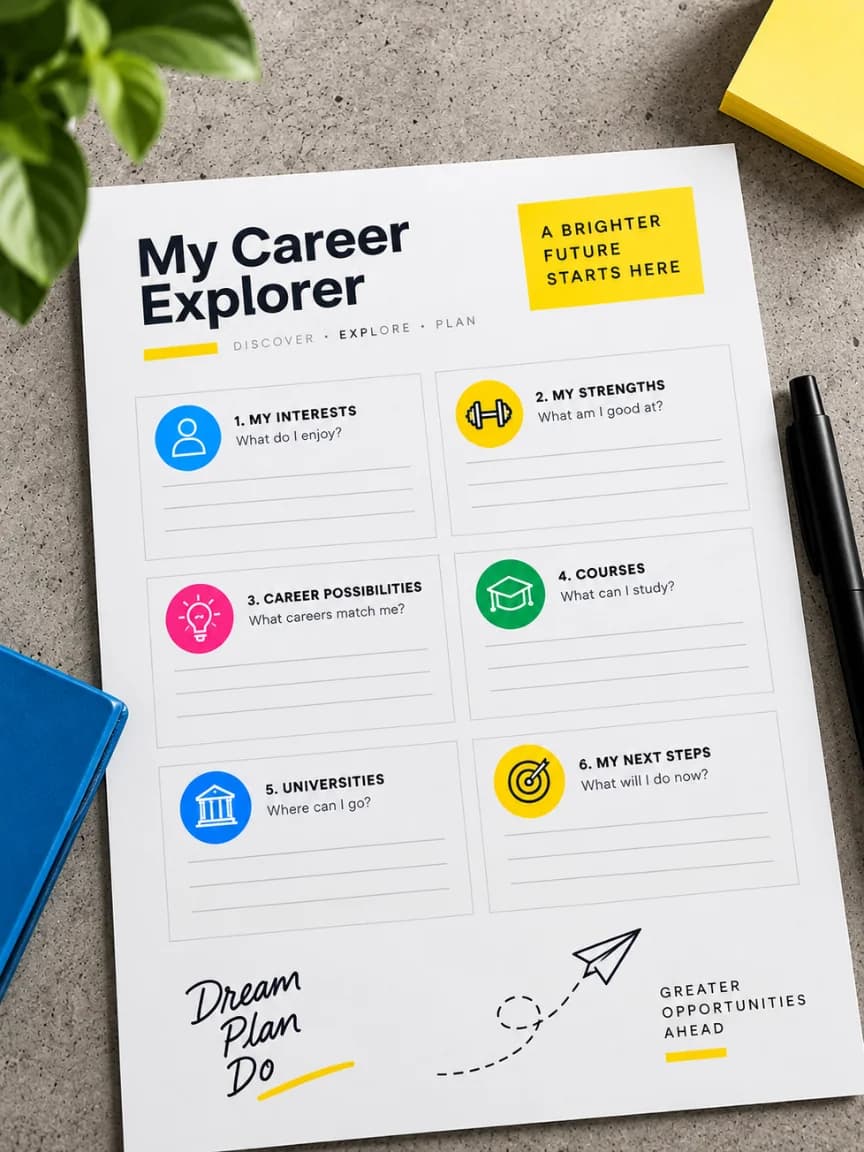 Career ExplorerTurn interests, strengths and values into a shortlist of careers worth testing.
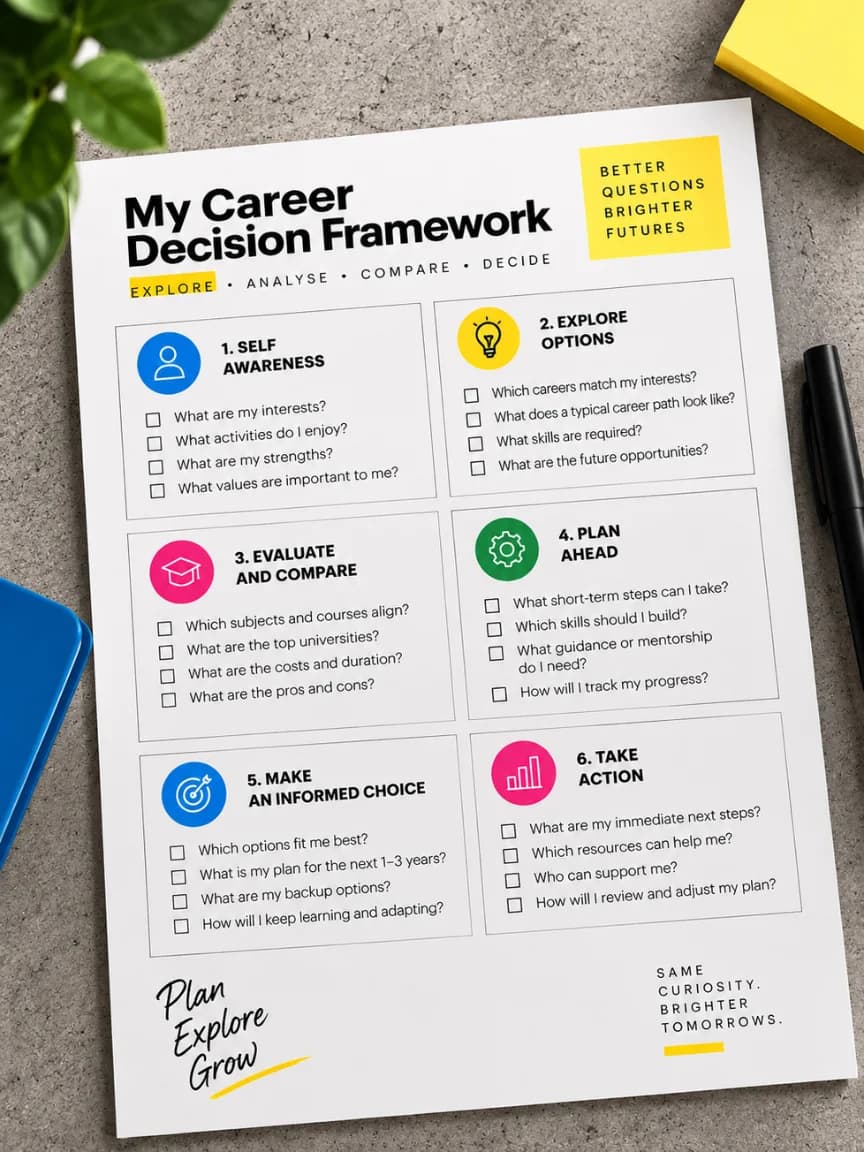 Career Decision FrameworkWeight what matters, score your options and see where you are unsure.
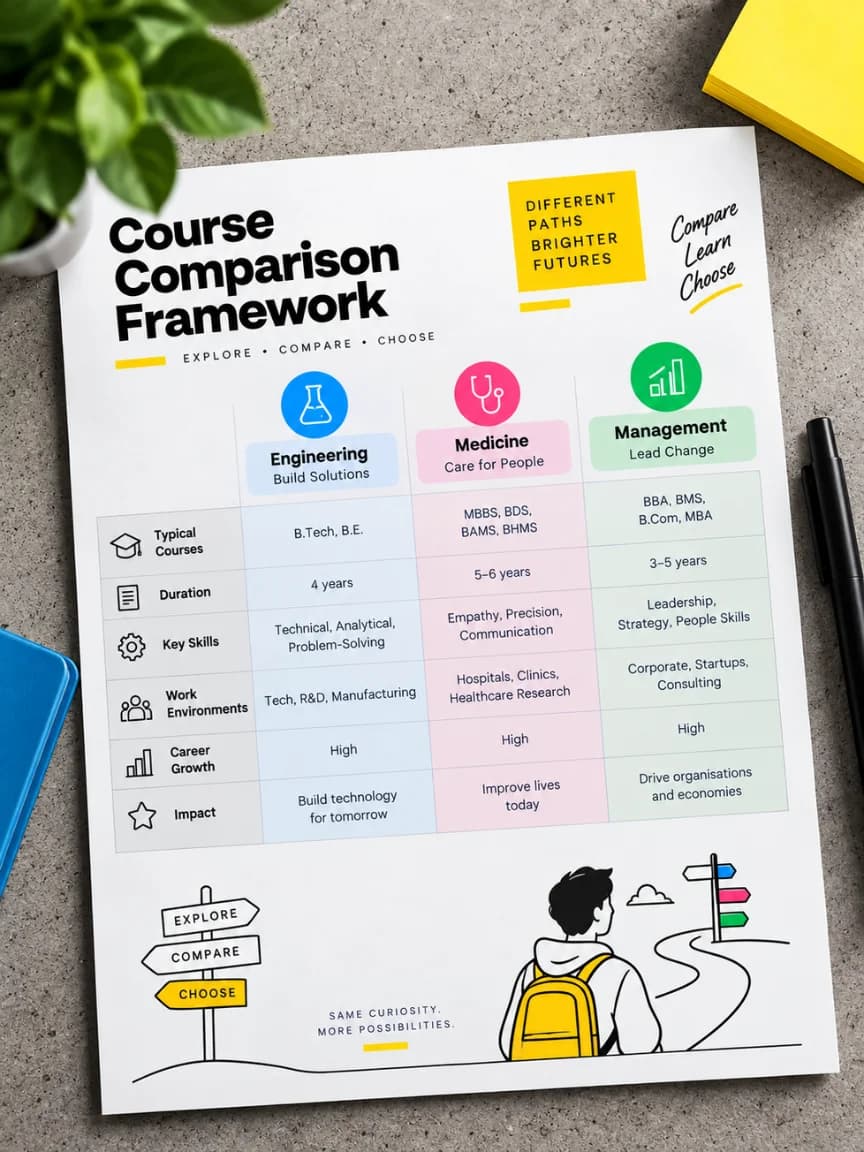 Course Comparison FrameworkCompare two degree programmes on curriculum, structure, cost and outcomes.
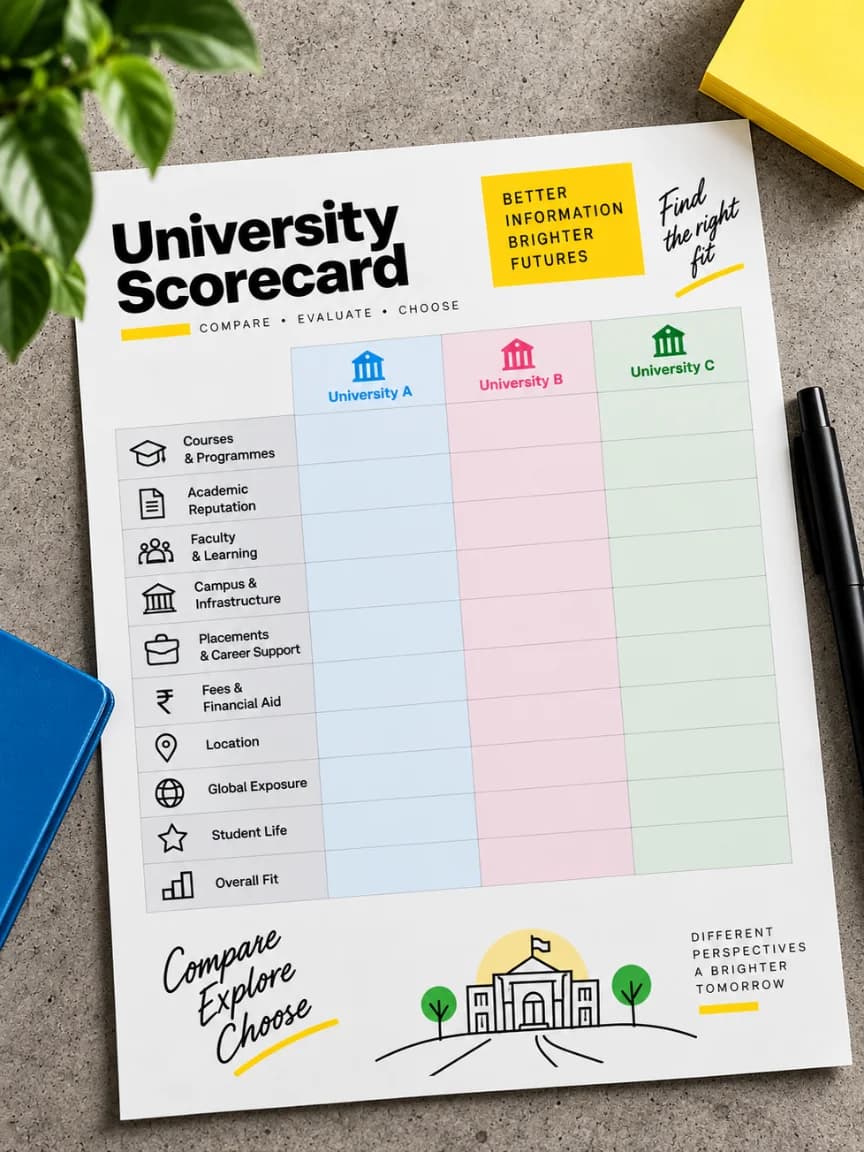 University ScorecardScore universities on the factors that matter to you, not a ranking alone.
More in the full FAQ.
No. It is a structured career-decision programme delivered through schools. Students first learn how to evaluate careers, courses and universities, then meet universities and experts with better questions.
No. The three-year model is a school partnership. Students join at the stage that fits them: EXPLORE (Grade 10 → 11), COMPARE (Grade 11 → 12) or DECIDE (Class 12 → University).
Day 1 is EXPLORE (Grade 10 → 11), Day 2 is COMPARE (Grade 11 → 12) and Day 3 is DECIDE (Class 12 → University). Some sessions may be open to other senior cohorts where the school agrees.
Yes. Parents may attend their child’s primary day and may be invited to other sessions, depending on school policy.
Yes, through the optional Post-Board University & Admissions Connect. That is a timeline within DECIDE (Class 12 → University), not a fourth programme stage, and it is subject to the school calendar, student participation and programme scheduling.
Not by default. Any data collection must be transparent, consent-based where required, purpose-specific and compliant with applicable law and school policy.
Schools, universities, speakers and partners each have a defined role. Tell us which one is yours.
Delhi NCR, India